


Pathway for Progress: Natural Gas and Addressing Energy Poverty
Bottom Line: Not just a problem for the still developing countries, energy poverty continues to exist in many forms across the U.S. People and communities of color are hit particularly hard by higher energy prices, making access to low-cost energy a matter of racial justice. Now supplying about 30% of U.S. energy and 40% of our electricity, natural gas is low-cost, abundant, reliable, and cleaner. For these reasons, gas must play an even greater role in helping to address America’s silent problem of energy poverty.
Many Americans might find it surprising that even in the U.S. energy poverty is a hidden weight dragging families across the country further into poverty and forcing unimaginable choices upon them.
This is simply unacceptable for us as a nation. For example, when electricity or heating prices increase, extreme winter conditions can force families into a ‘heat or eat’ dilemma.
Energy poverty, energy insecurity – these are different names for a similarly devastating problem: unequal or inadequate access to the vital electricity that powers modern life.
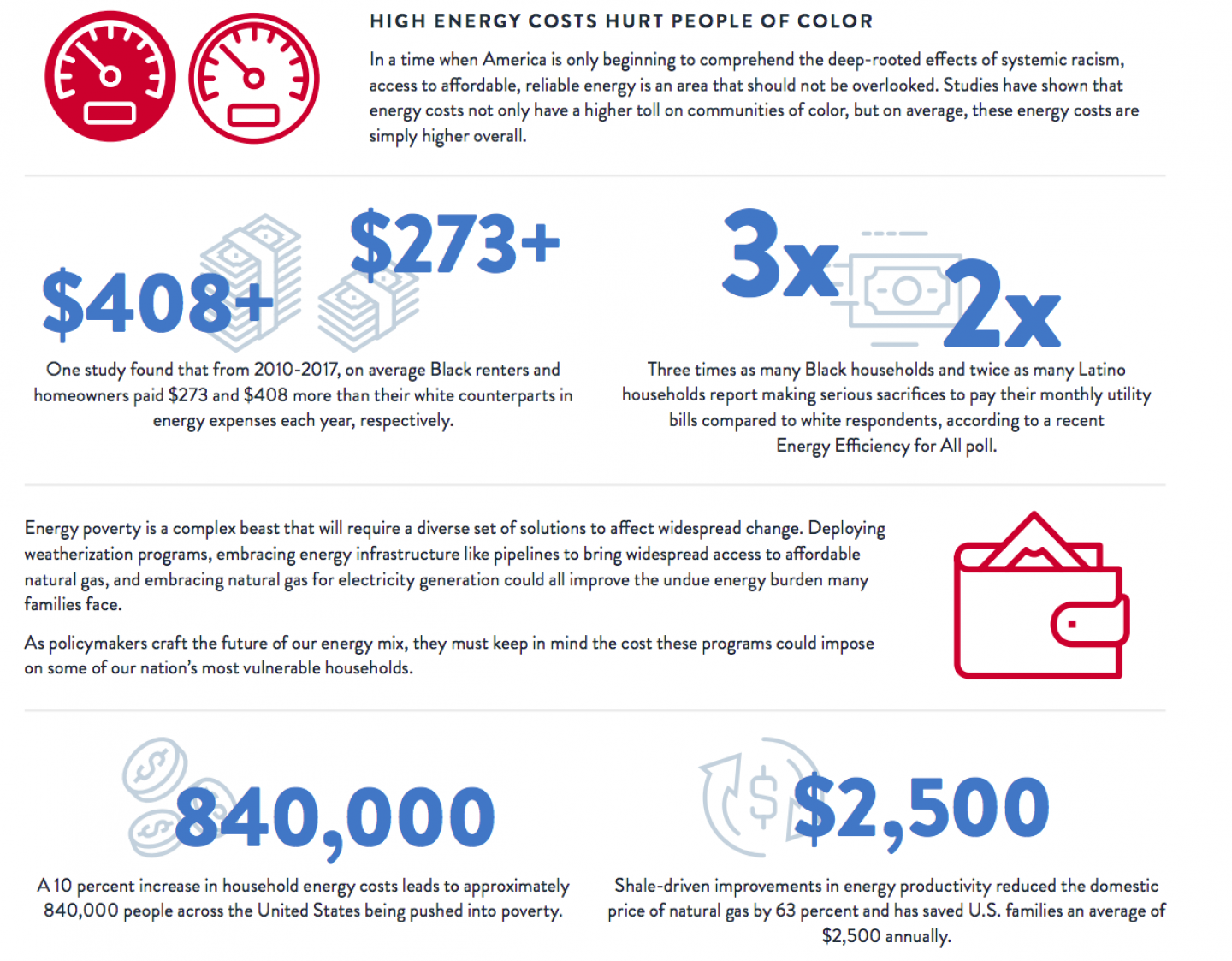
Indeed, higher cost energy is highly regressive since, as a percentage of their income, low-income Americans spend 4-7 times more on energy than wealthier ones.
While there is no one-size-fits-all solution to address energy poverty, it is certain that access to low-cost natural gas must continue to play a very important role.
The U.S. natural gas production boom since 2008 has increasingly installed a system of low-cost, abundant, and reliable energy. Gas is also a cleaner energy source with low emissions that also backups naturally intermittent wind and solar power.
In fact, it is vulnerable communities that suffer the most from high energy bills, at times driven higher by limited access to affordable energy sources like natural gas.
People and communities of color will continue to suffer most if low-cost natural gas is removed in favor of higher cost, less reliable energy systems, such as what renewables often are. Ultimately, this makes more access to low-cost natural gas a matter of racial justice.
Investment in energy infrastructure, particularly in rural or underserved areas, could provide the lift needed to bring many in those communities out of poverty.
And as a country, as we face future rising energy demands, we must not let those already suffering under high undue energy burdens to suffer even more.
Those seeking to stop natural gas pipelines or ban gas outright (e.g., New York, California) should ask themselves what the cost would be to the households that natural gas would serve.
While the future may be uncertain, what is assured is that the energy policy we craft in the coming years must not leave fellow Americans behind.
This is why more natural gas must remain a foundation to our national energy strategy.
Read the full study here.
Low-Cost Energy: A Matter of Racial Justice
Findings:
- Likely surprising to many Americans, energy poverty continues to exist in many forms across the U.S., forcing unacceptable hardships on American families.
- People and communities of color are particularly impacted, making access to low cost-energy a matter of racial justice.
- Low-cost, abundant, reliable, and cleaner, natural gas must play an even more integral role in our national energy strategy.
Read the full study here.
