


The Costs of an Unnecessarily Stringent Federal Data Privacy Law
Bottom Line: Federal legislation similar to the privacy laws in Europe or California could cost the U.S. economy approximately $122 billion per year, or $483 per U.S. adult. It would increase prices, reduce free access to products and services, and hinder innovation in ways that harm businesses and consumers. A better alternative would be a more focused national privacy law that would prevent states from implementing conflicting laws while only costing about $6 billion a year -- around 95 percent less.
Due to the need to preempt states from creating conflicting privacy rules, Congress is rightly considering substantial reforms to federal data privacy law. The key is ensuring that this forthcoming law both protects consumers and encourages continued innovation.
Congress must avoid modeling its legislation on the European Union’s new data protection law, the General Data Protection Regulation (GDPR), which has imposed significant costs and undermined innovation in the region, in favor of the light-touch approach that has allowed the U.S. digital economy to flourish.
While the Europeans ignore them, the costs of data privacy laws can be significant. As Congress crafts a new data privacy law, it should understand how decisions about which provisions to include can impact both the direct and indirect costs on businesses and consumers.
This report evaluates two types of costs associated with a federal data privacy law: compliance costs and market inefficiencies. Compliance costs include personnel companies must hire and capital costs they incur related to new regulations. Market inefficiencies are indirect costs that impact organizations by restricting productivity and economic value, including among organizations trying to innovate.
Congress should also understand that inaction itself has costs, especially given that many states are considering their own privacy legislation that could be even more costly than overly restrictive federal legislation because of the inefficiency of having no national standard.
Maximizing consumer welfare requires accounting for costs, because expensive rules increase prices (or reduce free access to products and services) and hinder the development of improved products and services. Federal data privacy legislation should not be a hidden tax on consumers.
Read the full study here.
Estimate of Costs Associated with Unnecessarily Stringent Federal Data Privacy Law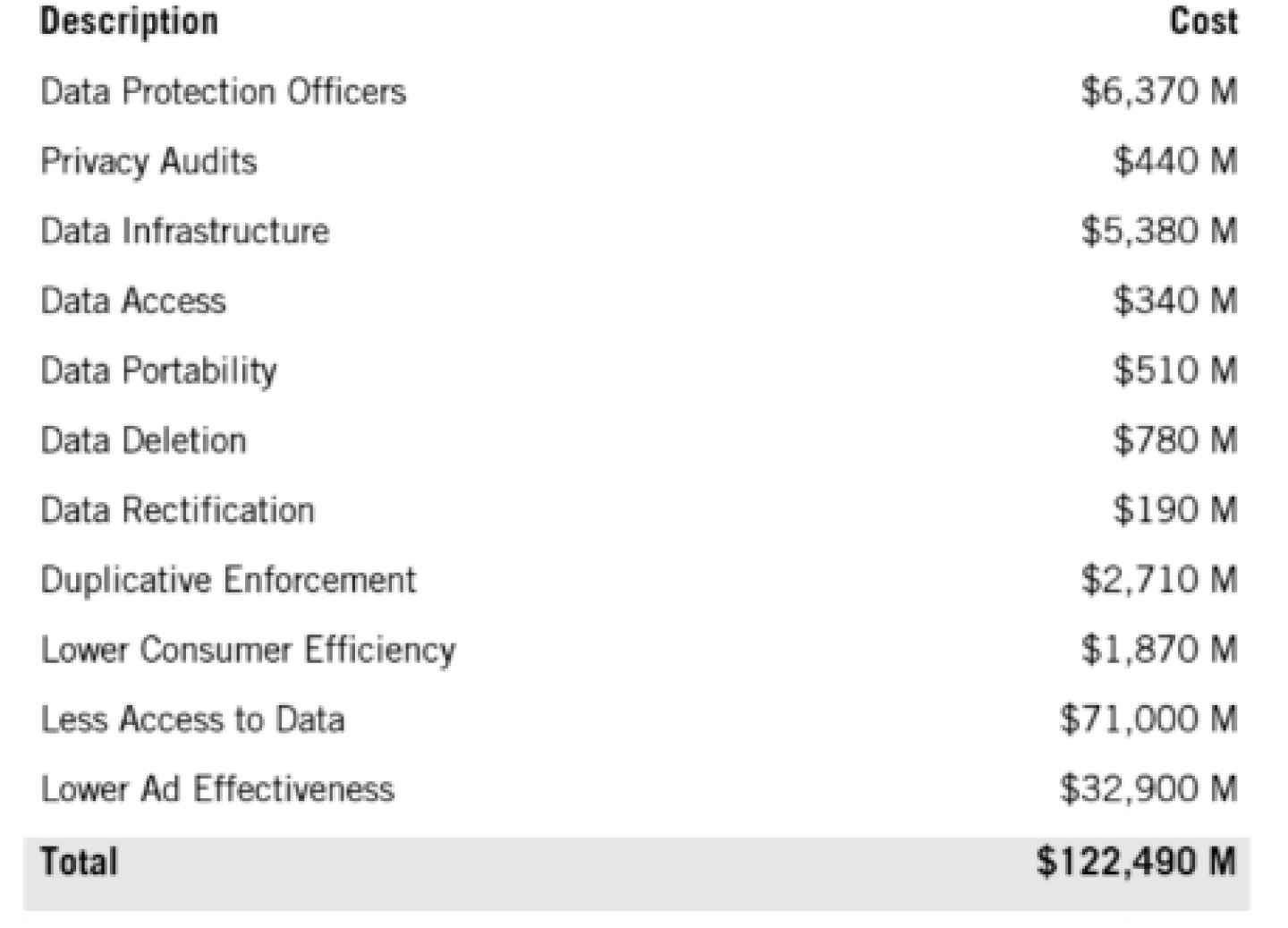
Findings:
- Federal legislation similar to the privacy laws in Europe or California could cost the U.S. economy approximately $122 billion per year, or $483 per U.S. adult.
- Such legislation would increase prices, reduce free access to products and services, and hinder innovation in ways that harm businesses and consumers.
- A better alternative would be a more focused national privacy law that would prevent states from implementing conflicting laws while only costing about $6 billion a year -- around 95 percent less.
